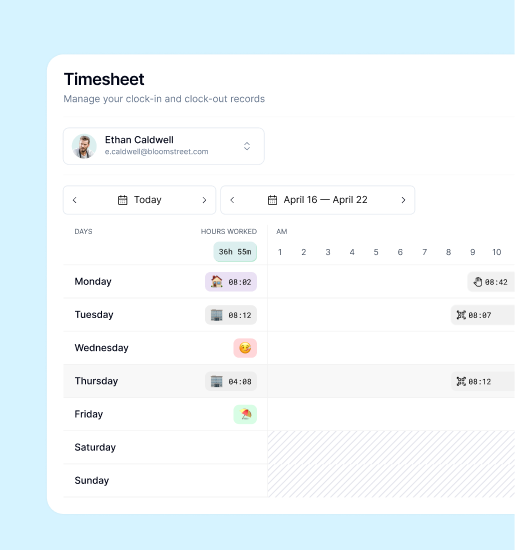
If your business operates in the European Union or the United Kingdom, every clock-in and clock-out record you collect is regulated personal data. GDPR-compliant time tracking is not a nice-to-have — it is a legal obligation. Yet many organisations are still running their attendance records on spreadsheets, paper sign-in sheets, or consumer apps that were never designed with data protection in mind.
This guide explains what GDPR-compliant time tracking looks like in practice, where most organisations fall short, and what you should demand from any time clock solution you adopt.
Why Time Tracking Data Falls Under the GDPR
Under the EU General Data Protection Regulation (GDPR) and its UK equivalent — the UK GDPR, which retained the core framework post-Brexit — “personal data” is defined broadly as any information relating to an identified or identifiable natural person. Employee time records fit squarely within that definition.
Specifically, the following data points collected during a normal time tracking process are personal data:
- Clock-in and clock-out timestamps linked to a named employee
- GPS or geolocation data captured during mobile or remote clocking
- Biometric identifiers used for fingerprint or facial recognition clock-ins
- IP addresses from web-based clocking systems
- Work schedules and shift patterns that reveal an individual’s daily routine
Biometric data used for authentication carries an even higher burden: it is classified as special category data under Article 9 of the GDPR and requires an explicit legal basis — typically explicit employee consent or a specific national law.
The bottom line is that if you collect it and it relates to an employee, the GDPR applies.
Key GDPR Principles That Apply to Time Tracking
Article 5 of the GDPR sets out the foundational principles that govern all processing of personal data. For HR teams managing time records, these translate into concrete obligations.
1. Lawfulness, Fairness and Transparency
You need a valid legal basis to process time tracking data. For most employers, the primary basis is legitimate interest (Article 6(1)(f)) — specifically, the business need to manage working time and comply with labour law. In several EU member states, national law mandates time tracking entirely, which itself constitutes a legal basis.
However, lawfulness alone is not enough. Employees must be told, in plain language, what data is collected, why it is processed, how long it is retained, and who has access to it. This information should appear in your employment contracts, staff handbook, or a dedicated employee privacy notice.
2. Purpose Limitation
Time tracking data collected for payroll and attendance management cannot subsequently be repurposed — for instance, to build a behavioural profile of employees or to monitor productivity beyond what was originally disclosed. If you want to extend the use of the data, you need to assess whether the new purpose is compatible and, where it is not, obtain a fresh legal basis.
3. Data Minimisation
Only collect what you actually need. If your legal obligation is to record daily working hours, you do not need precise GPS coordinates for office-based staff. Over-collecting data increases your exposure — both to enforcement action and to the risk of a breach.
4. Storage Limitation
Under Article 5(1)(e), personal data must not be kept for longer than is necessary. For employee time records, retention periods are usually driven by labour and tax law — typically four to six years across most EU jurisdictions. Whatever period applies in your country, it must be documented in a formal retention policy and enforced technically: data should be deleted or anonymised once the retention period expires, not simply left to accumulate indefinitely.
5. Integrity and Confidentiality
Time records must be protected against unauthorised access, alteration, and loss. This means encryption at rest and in transit, role-based access controls so that only authorised personnel can view or modify records, and audit trails that log every change.
The Most Common GDPR Compliance Mistakes in Time Tracking
GDPR enforcement against employers is increasing. As of 2024, data protection authorities (DPAs) across the EU have issued fines totalling over €5.8 billion since the regulation took effect in May 2018, with employee data and workplace monitoring among the most frequently cited categories. Smaller SME fines in the range of €5,000–€50,000 for procedural breaches are increasingly common.
Here are the compliance failures that appear most often:
Spreadsheets and Manual Systems
A shared Google Sheet or Excel file might feel convenient, but it creates serious risks. Access controls are difficult to enforce, changes leave no audit trail, data can be accidentally deleted, and personal data often ends up stored outside the EEA on consumer-grade infrastructure. Manual time tracking is not inherently illegal, but it is structurally hard to make compliant.
Storing Data on Personal Devices
When managers record employee hours on their personal phones or laptops, you lose all control over where that data is stored, who can access it, and whether it is ever deleted. This directly violates the integrity and confidentiality principle.
No Documented Retention Policy
Many organisations simply never delete old time records. Without a formal retention policy, you are keeping data “just in case” — which has no basis in GDPR and exposes you if an employee ever requests erasure or a DPA audits your systems.
Failing to Inform Employees
Employees have the right to know their data is being collected and why (Articles 13 and 14). Collecting time records without any privacy notice — or burying the disclosure in a contract no one reads — fails the transparency requirement and is one of the easiest violations for a DPA to identify.
Using Non-EU Vendors Without Safeguards
If your time tracking vendor stores or processes data outside the EEA, you need to ensure appropriate safeguards are in place — typically Standard Contractual Clauses (SCCs) or an adequacy decision covering the destination country. This applies equally under the UK GDPR, where the ICO has published its own International Data Transfer Agreements (IDTAs).
What to Look For in a GDPR-Compliant Time Tracking Solution
When evaluating a time clock or workforce management platform for use in the EU or UK, the following requirements are non-negotiable:
- Data stored on servers within the EU/EEA or explicit international transfer safeguards in the Data Processing Agreement
- A signed Data Processing Agreement (DPA) as required by Article 28 — any vendor processing personal data on your behalf must provide one
- End-to-end encryption for data in transit and at rest
- Role-based access controls limiting who can view time records to those with a legitimate need
- Immutable audit logs recording every access and modification to attendance data
- Employee self-service access so that staff can view and export their own records at any time, fulfilling the right of access under Article 15
- Configurable retention and deletion policies so you can enforce your documented retention schedule automatically
It is also worth asking vendors whether they have conducted a Data Protection Impact Assessment (DPIA) for their product. Under Article 35, DPIAs are mandatory for processing that is “likely to result in a high risk to the rights and freedoms of natural persons” — which biometric time clocks and large-scale employee monitoring systems typically meet.
How Kinmu Supports GDPR Compliance
A few of the features directly relevant to GDPR compliance:
EU data infrastructure. Kinmu stores all customer data on servers located within the European Economic Area. No personal data is transferred to third countries without appropriate safeguards.
Role-based permissions. Managers can only access the time records of employees within their assigned teams. Administrators control who can view, edit, or export data at a granular level.
Full audit trail. Every clock event, every edit, and every data export is logged with a timestamp and user identifier. This gives you a complete record for any internal audit or DPA inquiry.
Employee self-service portal. Employees can log into their own Kinmu account to view their complete time history, download their records, and request corrections — directly supporting your obligations under Articles 15 (right of access) and 16 (right to rectification).
Data Processing Agreement. Kinmu provides a GDPR-compliant DPA on request, satisfying the Article 28 requirement for a formal agreement between controller and processor.
Take the Complexity Out of Compliance
GDPR-compliant time tracking is achievable for businesses of any size — but it requires the right foundation. Spreadsheets, personal devices, and generic apps leave you exposed. A purpose-built solution with EU data residency, strong access controls, employee self-service, and a signed DPA removes the majority of the compliance risk at a stroke.
If you are ready to move to a time tracking system built for European compliance, get started with Kinmu today.