
Free calculator
Overtime calculator: time and a half and double time
Enter your hourly rate and the hours you worked each day. The calculator applies federal overtime or your state’s daily rules, and works out your regular rate with bonuses and shift differentials.
Enter your workweek
Choose your state, type your hourly rate and the hours you worked each day. Leave days off empty.
Gross pay this workweek
Regular rate
Why you get overtime
An estimate of gross pay before taxes and deductions, not legal or payroll advice. It applies to nonexempt employees: if you’re exempt, for example a salaried manager who meets the salary and duties tests, overtime rules don’t cover you. Everything stays in your browser: nothing you type is sent or saved.
How to calculate overtime pay
- Find your regular rate. Add up everything you earned for the hours you worked in the week, including promised bonuses and shift differentials, and divide it by those hours. With only an hourly wage, it’s your hourly rate.
- Count your overtime hours. Under the federal rule, the hours over 40 in the workweek. In a state with daily overtime, count each day first and then the week, and pay each hour only once, at the highest rate that applies.
- Multiply. Regular hours at the regular rate, overtime hours at 1.5 times, and double-time hours at 2 times. The sum is your gross pay for the week.
Overtime rules by state
The Fair Labor Standards Act sets the floor everywhere: time and a half for nonexempt employees after 40 hours in a workweek. When a state rule is more generous, you get the more generous one. The calculator covers:
- Federal rule and Texas. Over 40 hours a week. Texas has no overtime law of its own.
- California. Over 8 hours a day or 40 a week at time and a half, over 12 a day at double time, and the seventh consecutive day of the workweek: first 8 hours at time and a half, the rest at double time. With a valid alternative workweek schedule of up to 10 hours a day within 40 a week, daily overtime starts after your scheduled hours, and a day off the schedule is overtime from the first hour.
- Alaska. Over 8 hours a day or 40 a week, for employers with 4 or more employees.
- Nevada. Over 40 hours a week, and over 8 hours in a 24-hour period if you earn less than $18.00 an hour (1.5 times the state minimum wage).
- Colorado. Over 12 hours a day, over 12 consecutive hours or over 40 a week.
Other states can have their own rules for some jobs or industries. If yours isn’t on the list, the federal rule gives you the minimum, and your state labor department can tell you whether anything more applies.
Track the hours behind the overtime
Overtime is only as accurate as the hours it’s based on. If you start from clock-in and clock-out times, add them up first with the timesheet calculator, which also handles lunch breaks.
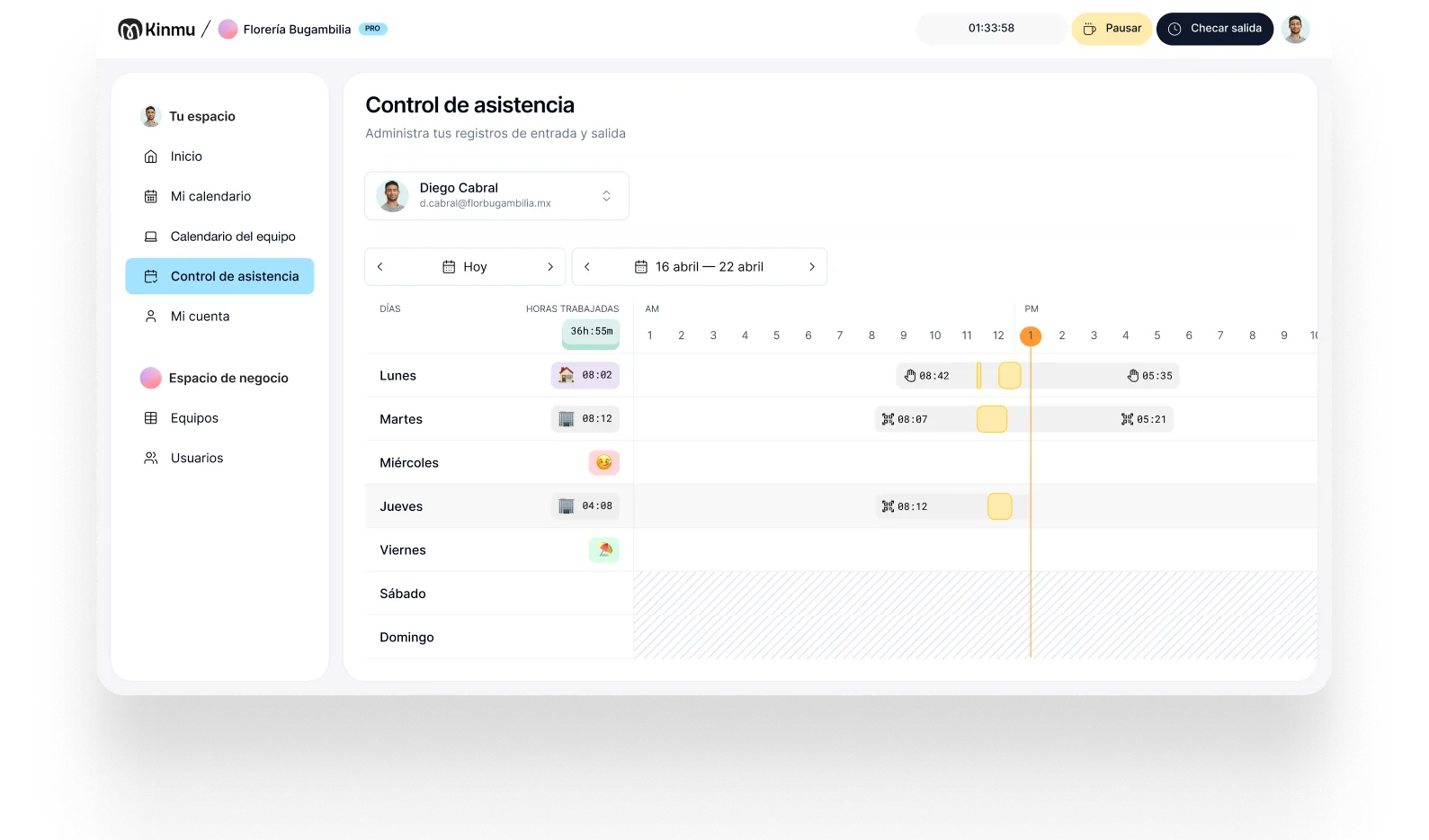
With Kinmu time tracking your team clocks in from their phone, and each workweek’s hours add up on their own. Plan around the 2027 federal holidays and your state holidays, too.
See overtime coming before it hits payroll
Try Kinmu for free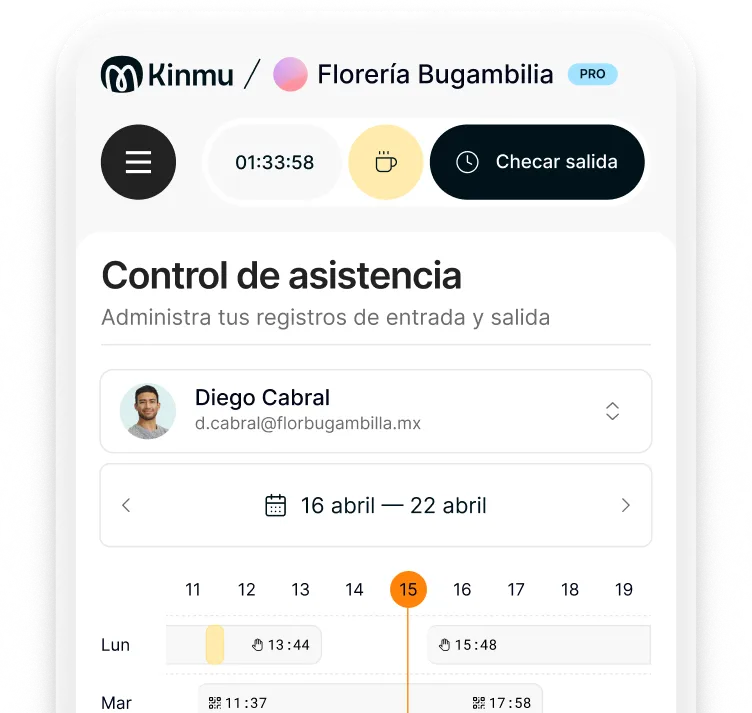
Frequently asked questions
How do I calculate overtime pay?
Add up the hours you worked in the workweek. Every hour over 40 is paid at 1.5 times your regular rate, which is time and a half. At $20 an hour, 46 hours is 40 × $20 = $800 plus 6 × $30 = $180, so $980.00 for the week. If your state has daily overtime, like California, count each day first.
What is time and a half?
Your regular rate times 1.5. At $20 an hour, time and a half is $30 an hour; at $15.50 it’s $23.25. Double time is your regular rate times 2, and only some states, like California, require it.
What is the regular rate of pay, and does a bonus change it?
It’s everything you earned for the hours you worked in the week divided by those hours (29 CFR 778.109). With only an hourly wage, it’s your hourly rate. Promised bonuses, commissions and shift differentials go in too. The Department of Labor’s own example: $12 an hour for 46 hours plus a $46 production bonus makes $598, which is a regular rate of $13.00. Overtime is then 1.5 × $13 = $19.50, for a total of $637.00 (29 CFR 778.110). Discretionary bonuses and holiday gifts are left out.
How does overtime work in California?
California pays time and a half over 8 hours in a workday and over 40 in a workweek, and double time over 12 hours a day. Four 10-hour days at $20 make $880.00 in California: 32 regular hours and 8 hours of daily overtime. Under the federal rule alone, the same 40 hours are $800.00, all at the regular rate.
What is the seventh-day rule in California?
If you work all seven days of the workweek, the first 8 hours of the seventh day are paid at time and a half and any hour after 8 at double time. Six 8-hour days and 10 hours on the seventh, at $20, make $1,360.00: 40 regular hours, 16 at time and a half (8 over the weekly 40 and 8 on the seventh day) and 2 at double time. A day off anywhere in the workweek breaks the run.
How does overtime work in Texas?
Texas has no overtime law of its own: its minimum wage law leaves out work already covered by the federal Fair Labor Standards Act. So in Texas you get time and a half for hours over 40 in the workweek, with no daily overtime. Four 10-hour days are $800.00 at $20 an hour, with no overtime.
Do I get overtime for working weekends or holidays?
Not under federal law. The FLSA doesn’t require overtime for work on Saturdays, Sundays or holidays as such: only the hours over 40 in the workweek count. Your employer can pay more for those days if your contract or company policy says so.
Does the calculator include taxes?
No. It shows your gross pay, before federal and state income tax, Social Security, Medicare and any other deductions. What lands in your bank account will be lower, and depends on your W-4, your state and your benefits.
Who doesn’t get overtime?
Exempt employees. The most common exemptions are for executive, administrative and professional employees paid on a salary basis of at least $684 a week who also meet a duties test. A job title or being salaried isn’t enough on its own. Some states set a higher salary level, so check yours.
Can my employer average two weeks to avoid overtime?
No. Each workweek stands alone (29 CFR 778.104): 30 hours one week and 50 the next means 10 hours of overtime in the second week. Your workweek is a fixed period of seven consecutive days that can start on any day, which you can choose in the calculator.
Official sources
- 29 U.S.C. 207(a)(1), Fair Labor Standards Act: overtime over 40 hours
- U.S. Department of Labor, Fact Sheet #23: Overtime pay requirements of the FLSA
- U.S. Department of Labor, Fact Sheet #56A: Overview of the regular rate of pay
- 29 CFR 778.109 and 778.110: the regular rate, with an hourly rate and a bonus
- 29 CFR 778.207 to 778.211: shift differentials, bonuses and discretionary bonuses
- 29 CFR 778.103 to 778.105: the workweek, and why each one stands alone
- U.S. Department of Labor: salary level for the executive, administrative and professional exemptions
- California Department of Industrial Relations (DLSE): overtime FAQ, Labor Code 510
- California DLSE glossary: workday and workweek
- California Wage Order 4, section 3(B): alternative workweek schedules
- Alaska Department of Labor: Wage and Hour Act, overtime
- Nevada Revised Statutes 608.018: overtime
- Nevada Labor Commissioner: Daily overtime, 2026 annual bulletin
- Colorado Department of Labor and Employment: COMPS Order poster, effective 1/1/2026
- U.S. Department of Labor: state minimum wage and overtime laws (Texas, Alaska, Nevada, Colorado)
Data reviewed on October 12, 2026.